
A snapshot of our recent research featured in scientific journals
Ancient viruses as gene delivery couriers to help bacteria resist antibiotics
Research has shed important new light on the enemies-turned-allies that allow bacteria to exchange genes, including those linked to antimicrobial resistance.
Gene transfer agents (GTAs) are gene-carrying particles domesticated from ancient viruses for beneficial use by bacterial host cells. Acting as couriers, they take parcels of host bacterial DNA and deliver them to other bacteria, rapidly spreading traits like antibiotic resistance.
Scientists have now identified a ‘control hub’ critical for breaking down host cells to release GTAs.
First author of the study Dr Emma Banks said: “The identified ‘control hub’ looks like an immune system, yet bacteria are using it to release GTAs. It suggests that immune systems could be repurposed to help bacteria share DNA, potentially contributing to the spread of antibiotic resistance.”
An exciting new landscape of protein-related discovery unfolds
A collaboration between Professor Tung Le’s group and Cambridge University investigated ParB, a protein vital to DNA segregation and cell survival.
Building on previous research in bacteria, this study revealed the structural component that enables CTP binding (the ParB-CTPase fold) extends further than previously thought, across many forms of life, including archaea, eukaryotes and viruses. It is also versatile, binding to other nucleotides including ATP and GTP, suggesting previously unrecognised biological functions.
Co-first and co-corresponding author from the John Innes Centre, Dr Jovana Kaljević, said: “This shows that evolution has repeatedly repurposed the same molecular architecture for entirely divergent functions across all domains of life.”
This discovery could lead to insights into genetic regulation, biotechnology applications, and new strategies for tackling antimicrobial resistance.
The ‘virtual scientist’ making AI-powered plant discovery a reality
Researchers from Professor Yiliang Ding FRSB’s group have developed a ‘virtual plant scientist’ powered by artificial intelligence (AI).
Dr Haopeng Yu, who led the development of Plantscience.ai, explained: “This transformative tool has memory of millions of plant biology papers and can explain how one gene relates to another, complete with the original references. It doesn’t replace plant scientists but frees up their time to address the big questions in biology.”
In technical fields, general-purpose AI tools are prone to plausible sounding fabrications. However, PlantScience.ai uses a specialised plant-specific knowledge graph, and its dynamic automated learning pipeline (AutoSKG) continuously updates its knowledge.
The team hopes to progress from question-and-answer interactions towards features that can tackle more complex scientific problems and deeper data analysis.
How maternal messages prime seeds for success
Researchers at the John Innes Centre and Earlham Institute investigated whether developing plant seeds directly sense their environment or gain ‘seasonal’ information from their parents.
Single cell technology enabled molecular analysis of Arabidopsis cells within the context of their tissue environment. The plant growth inhibitor abscisic acid (ABA) increased in plant specific maternal reproductive tissues when the temperature dropped, helping developing seeds enter dormancy until conditions improved.
This study, highlighting how hormonal transport can influence traits in the next generation, introduces a new tool for developing climate-smart crops.
Professor Steve Penfield, Group Leader, explained: “Plants don’t rely solely on evolution or changes in genetics to survive; they can simply acquire the right amount of hormone to pre-adapt seeds to the environment that the mother has experienced.”
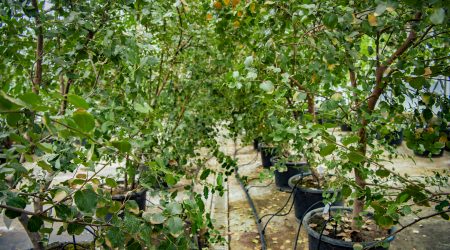
Dr Elizabeth Orton with ash saplings in the John Innes Centre polytunnels
The fast-track tree breeding method restoring ash to the landscape
A fast-track method of breeding disease-resistant European ash trees has been developed by researchers, accelerating seed germination from up to six years in nature to around one week in the lab.
This novel seed germination protocol involves removing the embryo, bypassing seed dormancy, and placing it on an agar nutrient jelly. The European ash dieback epidemic has created urgent need to propagate new populations with resistance to the disease. This method offers hope for the species’ restoration.
Dr Elizabeth Orton, John Innes Centre researcher and first author of the study, said: “Once modified, non-specialists could adopt the technique to support local efforts in growing diverse ash populations.”
Associated Scientists



Publications
- Versatile NTP recognition and domain fusions expand the functional repertoire of the ParB-CTPase fold beyond chromosome segregation. (2025) Proceedings of the National Academy of Sciences of the United States of America
- PlantScience.ai: An LLM-powered virtual scientist for plant science (2026) Molecular Plant (19)
- Adaptation of seed dormancy to maternal climate occurs via intergenerational transport of abscisic acid. (2025) Proceedings of the National Academy of Sciences of the United States of America
- Rapid germination of seeds of European ash ( Fraxinus excelsior ) to restore populations in the face of ash dieback (2026) Scandinavian Journal of Forest Research
- A bacterial CARD-NLR-like immune system controls the release of gene transfer agents. (2026) Nature Microbiology
Share