Inside the tissues of the Chilean soapbark tree is a substance valued at around $100,000 per gram that is attracting interest from pharmaceutical and commercial sectors worldwide. However, this newfound fame stems from humble beginnings
John Innes Centre Group Leader Professor Anne Osbourn OBE FRS NAS, who has delved deep into the history of Quillaja saponaria Molina, calls it ‘The Cinderella Tree.’
Before it became famous, the Chilean soapbark tree was a traditional source of soap and shampoo, while its hard wood was put to practical purpose, such as being carved into stirrups.
Unlike the Canelo tree, a Chilean evergreen revered by the indigenous Mapuche, it has no apparent religious or ceremonial associations, and it was largely ignored by European collectors who combed South America in the 1700s for plants of botanical and commercial interest.
In terms of commercial value, it was overshadowed by the quinine tree Cinchona pubescens, which was highly prized for its anti-malarial properties. In fact, when Charles Darwin travelled through the region where the tree grows in the 1830s, his diary records his attraction to the orange-flowered Berberis darwinii, which has now become an invasive species in some parts of the world. As Professor Osbourn notes: “The more discreet quillaja tree tended to go largely unnoticed despite its magnificent tall stature and beautiful star-like flowers.”
Soapbark illustration from Curtis's Botanical Magazine, third series, volume LIII (1897), plate 7568 (Rare Books, John Innes Historic Collections, courtesy of the John Innes Foundation)
From soap star to hall of fame
In the 1900s, serendipitous research by Gaston Ramon, a French veterinarian working at the Pasteur Institute, changed the fortunes of the soapbark tree. When he was testing vaccinations for horses, Ramon realised that local inflammation at an inoculation site was associated with more effective vaccination results. He tested various substances that were irritating to the tissues in his injections, including ‘saponin’, which is made naturally by the soapbark tree. These tests proved that the tree-produced compound was also an adjuvant, or a substance that can boost immune responses to vaccines.
QS-21 is a kind of saponin, a compound found across the plant kingdom which is one of the largest groups of plant natural products. It was approved for use in human vaccines in 2017, which accounts for its current elevated value. QS-21 is a critical component of commercial vaccines for malaria, shingles and syncytial virus, and a further 40 or more vaccines under development.
The compound is mainly sourced by extraction from the bark of wild soapbark trees and, with more vaccines approved for human use, there is increasing concern about the sustainable supply of QS-21.
It takes 25 years of growth before the bark is ready for harvesting. In some cases, bark is stripped from the base of the trunk causing the tree to die, leading to concerns about deforestation.
Extracting the bark is laborious and expensive and not always successful; only around five out of every hundred soapbark trees contain enough QS-21 to make the process commercially viable.
Further concerns relate to the potential impact of natural disasters such as drought and wildfires on populations of soapbark, most of which are wild, and the fact that QS-21 is an extremely complicated molecule, thwarting many attempts over the years to make it synthetically in the lab.
Professor Anne Osbourn in front of Chilean soapbark trees
Free from tree
Research by the Osbourn group and its industrial collaborators is excitingly poised to fill this gap after the discovery of a way to produce quantities of QS-21 ‘free from tree’, using substitute host plants.
Using a combination of artificial intelligence-assisted genome mining and engineering biology advances, they have successfully made QS-21 using plant expression technology pioneered at the John Innes Centre.
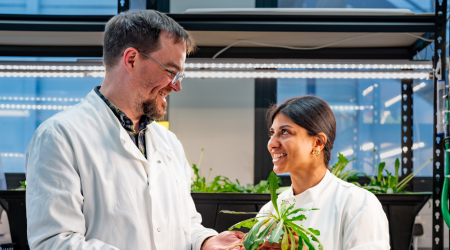
To do this, they sequenced the 30,000 genes that make up the Quillaja saponaria genome. Using this genetic map and AI-assisted computational techniques, they traced the 20 genes and enzymes that make up the QS-21 biochemical pathway. Then they transferred these genes into fast growing Nicotiana benthamiana, a relative of tobacco.
From here, the N. benthamiana plants take over, using the machinery of the cell to read the genetic instructions to produce quantities of this valuable medical molecule at a small scale.
Building on this research, Professor Osbourn has cofounded a spin-out company, HotHouse Therapeutics, for scalable and rapid generation of improved adjuvants and other drug leads, through the reengineering of plant biosynthetic processes.
Happy ever after for the Cinderella tree?
The research means that the soapbark tree, overlooked for so many years, is now among the most highly prized members of the plant kingdom, a vital source of the next generation adjuvants for vaccines of the future.
This is based on an original review by Professor Osbourn in Plants, People, Planet.
DOI: 10.1002/ppp3.70108
Associated Scientists

Publications
Share