
Professor Cristóbal Uauy
Director Delivering Sustainable Wheat (DSW), Building Robustness in Crops (BRiC)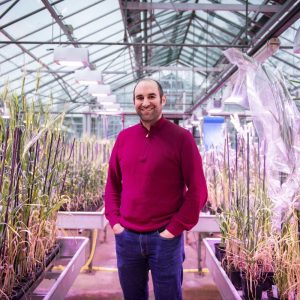
The Uauy lab is focused on using genetics and genomics to improve both yield and quality components in wheat.
Their research comes under three main areas;
The lab uses molecular genetic approaches to identify genes involved in wheat productivity traits and enhance the translation of this knowledge into improved varieties for industry and consumers.
They aim to understand the mechanisms by which these genes function in order to develop the most rational strategies to deploy these genes into commercial varieties.
Selected Publications
-
Long KA, Lister A, Jones MRW, Adamski NM, Ellis RE, Chedid C, Carpenter SJ, Liu X, Backhaus AE, Goldson A, Knitlhoffer V, Pei Y, Vickers M, Steuernagel B, Kaithakottil GG, Xiao J, Haerty W, Macaulay IC, Uauy C (2024)Spatial Transcriptomics Reveals Expression Gradients in Developing Wheat Inflorescences at Cellular Resolution
-
Cheng S, Feng C, Wingen LU, Cheng H, Riche AB, Jiang M, Leverington-Waite M, Huang Z, Collier S, Orford S, Wang X, Awal R, Barker G, O'Hara T, Lister C, Siluveru A, Quiroz-Chávez J, Ramírez-González RH, Bryant R, Berry S, Bansal U, Bariana HS, Bennett MJ, Bicego B, Bilham L, Brown JKM, Burridge A, Burt C, Buurman M, Castle M, Chartrain L, Chen B, Denbel W, Elkot AF, Fenwick P, Feuerhelm D, Foulkes J, Gaju O, Gauley A, Gaurav K, Hafeez AN, Han R, Horler R, Hou J, Iqbal MS, Kerton M, Kondic-Spica A, Kowalski A, Lage J, Li X, Liu H, Liu S, Lovegrove A, Ma L, Mumford C, Parmar S, Philp C, Playford D, Przewieslik-Allen AM, Sarfraz Z, Schafer D, Shewry PR, Shi Y, Slafer GA, Song B, Song B, Steele D, Steuernagel B, Tailby P, Tyrrell S, Waheed A, Wamalwa MN, Wang X, Wei Y, Winfield M, Wu S, Wu Y, Wulff BBH, Xian W, Xu Y, Xu Y, Yuan Q, Zhang X, Edwards KJ, Dixon L, Nicholson P, Chayut N, Hawkesford MJ, Uauy C, Sanders D, Huang S, Griffiths S (2024)Harnessing landrace diversity empowers wheat breeding.NaturePublisher's version: 0028-0836
-
Backhaus A, Griffiths C, Vergara Cruces A, Simmonds J, Lee R, Morris RJ, Uauy (2023)Delayed development of basal spikelets in wheat explains their increased floret abortion and rudimentary nature
Opportunities
We do not have current openings, but enquiries to join the group from interested Postgraduate and Postdoctoral Scientists are always welcomed.
Fellowship and PhD studentship positions can potentially be funded by the BBSRC, EU or John Innes Centre.