Plant science and microbiology laboratory design given the planning green light
The John Innes Centre and The Sainsbury Laboratory are developing a world-class plant and microbial research hub as part of the Next Generation Infrastructure programme.
We are delighted to announce that South Norfolk District Council have approved planning permission for the Main Laboratory Building (MLB), which will provide modern laboratory and office space, integrated technology platforms, training facilities, and collaborative areas at the heart of the Norwich Research Park.
Professor Cristóbal Uauy, Director of the John Innes Centre, said: “Securing planning permission for the MLB is a fantastic milestone, allowing us to continue our ambition to deliver the infrastructure our scientists need to shape future innovations. As climate pressure grows, it is vital that plant and microbial science is equipped to support the UK to lead the way in the development of resilient crops, healthier foods and sustainable molecules for vaccines and new medicines.”
Professor Nick Talbot, Executive Director, The Sainsbury Laboratory, said: “The MLB is a bold realisation of our ambitious Healthy Plants, Healthy People, Healthy Planet vision. This new building will be a powerhouse for plant and microbial science, with a forward-looking, flexible design that allows us to push the boundaries of research and future-proof our labs.”
Designed to meet the evolving scientific requirements of the two research institutes, the MLB is built to adapt – ensuring the UK remains at the global forefront of research and innovation.
Leader of South Norfolk Council, Daniel Elmer, said: “This is really exciting news for our district and the wider region. South Norfolk Council has long been a supporter of Norwich Research Park, investing to build essential infrastructure to unlock development opportunities. It’s fantastic to see the success of that investment and the potential for this centre of excellence being fulfilled.”
The MLB design, developed by lead architects BDP, has an open and social ethos at its core. With neighbourhoods of offices laboratories and collaborative spaces across each floor, the layout aims enable an inclusive culture, and foster collaboration and knowledge exchange.
Keith Papa, Head of Science, Technology and Research at BDP, said: “Innovative design is fundamental to creating sustainable research environments that accelerate scientific discovery. As the centrepiece of the redevelopment of the John Innes Centre and The Sainsbury Laboratory, it brings together people, research and specialist facilities to form a world-class hub for plant and microbial science, embedded within a welcoming landscape that connects the University of East Anglia with the Norwich Research Park.”
Designed for flexibility and future research needs, the building aims to achieve the UK’s Net Zero Carbon Building Standard through a low carbon design. Long-term resilience, accessibility and inclusion have shaped the building and landscape design, improving connectivity across the Norwich Research Park with new walking and cycling routes and enhancing biodiversity through meadows, native trees, and wetlands.
The Next Generation Infrastructure programme and the Healthy Plants, Healthy People, Healthy Planet vision are supported by the UKRI Infrastructure Fund, UKRI-BBSRC, the Gatsby Charitable Foundation, the University of East Anglia, the John Innes Foundation, the Wolfson Foundation and the Garfield Weston Foundation.
Fact File – Main Laboratory Building (MLB)
- Architects: BDP
- SNDC Planning Reference: 2025/1649
- Size: 21,000m², of which approximately 12,000m² will be laboratories.
- Location: John Innes Centre, Norwich Research Park
- Start Date: Construction is scheduled to start in 2028
- Includes: Laboratories, Offices, Meeting Rooms, Social and Catering, Training and connects to support building.
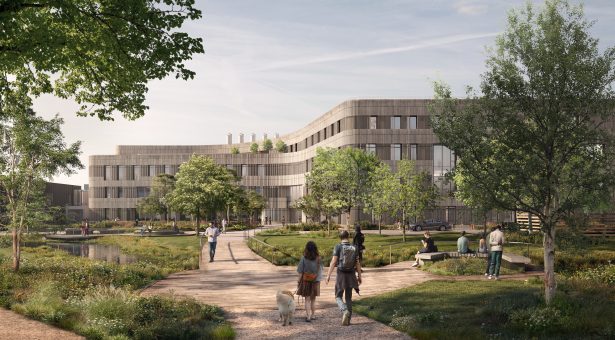
Image CGI of the JIC and TSL Next Generation Infrastructure main lab building
Credit BDP Secchi Smith