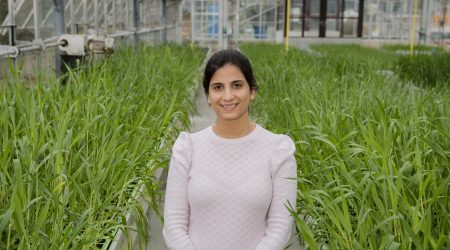
Professional Internships for PhD students (PIPS) in Africa
Since 2017, we have supported Professional Internships for PhD students (PIPS) in Kenya, focussed on communications, capacity building and building research networks
Read the storySince 2017, we have supported Professional Internships for PhD students (PIPS) in Kenya, focussed on communications, capacity building and building research networks
Read the storyFTMA is a pioneering scheme that promotes the movement of early-career researchers either from or to the John Innes Centre. For a personal take on what the scheme can mean, we spoke to Dr Inmaculada Ferriol-Safont, a Postdoc who joined us from CRAG in Barcelona
Read the storyXylella is not present in the UK, but should it arrive, then the eco-epidemiology needs to be understood. However, there is a great deal of uncertainty over the UK pathosystem compared to the known outbreak locations. This BRIGIT Consortium Meeting session will present the latest Xylella findings from the BRIGIT project, shedding light on some of the uncertainties in a UK context
Read the storyDevelopment of Xylella diagnostics tools and how these tools are being made available to stakeholders is a half day virtual event hosted by the BRIGIT consortium
Read the storyThe latest advances in our understanding of the plant immune system are mapped out in a new review by John Innes Centre researchers
Read the storyResearchers working to develop crops with healthier, more resistant starch at the Quadram Institute and John Innes Centre are partnering with the John Innes Foundation, who will be funding a two year collaborative research programme
Read the storyDr Kevin Pyke completed his PhD on leafless and semi-leafless peas, here at the John Innes Centre in the 1980s. We recently caught up with Kevin, to talk peas, PhDs, four-colour graphs and the John Innes Cricket team
Read the storyA type of wrinkled ‘super pea’ may help control blood sugar levels and could reduce the risk of type 2 diabetes, as suggested by a new study
Read the storyNumerous examples of biosynthetic gene clusters (BGCs) have been discovered in plant genomes, but little is known about the formation of these important examples of gene organisation
Read the story