There is never a right time — how institutional support makes academic careers possible
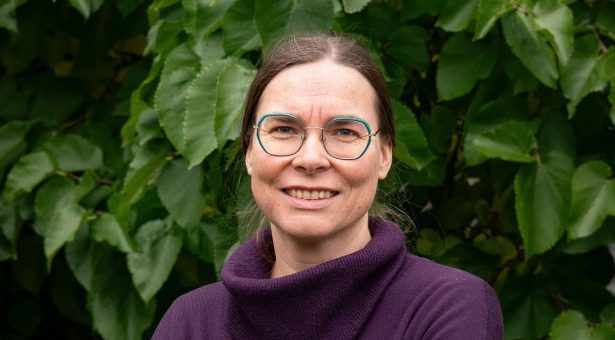
Dr Pirita Paajanen, senior scientist, will soon be moving on from JIC to set up her own research group at the University of Helsinki. In this blog she reflects on the support she has received from the institute to help her get to the next step in her career, and the transformative impact that the Leaders Plus fellowship programme has had on her, both professionally and personally.
The decision to have children when you work in research is a difficult one. It will have a major impact on your career, especially if you are a woman.
I am a senior scientist at John Innes Centre and a mother of three children: two teenagers and a primary-aged child. How did I manage to combine a career in science with having a big family? The honest answer is that there is never a ‘right’ time to have children. But institutional support can make all the difference in making it manageable.
I had my first two children while holding a three-year independent postdoctoral fellowship in pure mathematics from the Academy of Finland. In practice, the fellowship lasted nearly six years, because it was extended to cover my maternity leaves. During that time, my husband (whom I met while we were both doing our DPhils in Oxford) secured a faculty job at the University of East Anglia in Norwich. I therefore had to relocate, raise two small children away from my support networks, and rethink my career.
Changing fields while raising children
I chose to move into biology. Norwich Research Park is a major employer, and through a friend I heard about fascinating problems in genomics where mathematics could be applied. I had studied biology up to age 19, so while I lacked an undergraduate degree’s worth of formal training, I did have a foundation.
But how does a research mathematician become a research biologist? My first role was not in Norwich but at the Sanger Institute near Cambridge. I commuted once a week (2.5 hours each way), worked from home two days a week, and spent the remaining time caring for my children. The commute was brutal. I would sneak out at 6 a.m. before anyone else was awake, and by the time I returned after 8 p.m. the children were already asleep.
After childcare and commuting costs, I earned a whopping £30 a month. But it was worth it. I was doing science at a world-leading institute, and it gave me space to be something other than “just” a mother. It sparked my curiosity in a new field and helped me rebuild a scientific identity. But it was not sustainable long-term. With two small children, I needed work closer to home and earn more than pocket money.
I secured a position as a computational biologist at the Earlham Institute and two years later moved to a postdoctoral role at the John Innes Centre, where I have been ever since. By then, my older children had started school, and we were settled. I had successfully become a research biologist.
When careful planning fails
Two years into my postdoc, I had my third child. This time, everything was carefully planned, including a much shorter maternity leave. However, things did not go as expected. To paraphrase Oscar Wilde: “To lose one group leader during maternity leave may be regarded as a misfortune; to lose two looks like carelessness.”
When I returned from leave, I found myself without a group to return to, despite having collaborated closely with two groups beforehand. This is where institutional policy quite literally saved my career. The John Innes Centre has a policy where short-term contracts can be extended if they expire during maternity leave. That extension allowed me to finish a critical paper and avoid falling off the academic ladder entirely.
At that point, I had to rethink my priorities. Moving institutions with two school-aged children and a toddler was not realistic. Life was already demanding enough in a familiar place. I therefore applied for a support scientist role in the informatics platform. I settled into a senior bioinformatician position and received my first-ever indefinite contract. I felt incredibly lucky; I had a stable job and a continuing career in science.
Stability and restlessness
But I crave new things. I have tried many times in my life to quench my curiosity, but I cannot. If I am not at the cutting edge of knowledge, constantly satisfying my curiosity, I become restless.
After eight years at the John Innes Centre, I wanted clarity about where to go next. Career progression in a platform role can be limited, and while the best part of the job was diving into new collaborations and learning very different aspects of biology, I felt I had learned everything the role could offer.
I wanted to know whether I truly wanted to pursue a PI or group leader position, despite knowing how difficult that is from a support role, or whether I should transition into industry. By this point, my older children were teenagers, and for the first time I could see, faintly, the horizon where they would eventually leave home.
That was when I heard the John Innes Centre was running a pilot to support someone to apply to the Leaders Plus programme. Leaders Plus is a social enterprise which helps working parents progress in their careers while balancing family life. I applied and was successful.
Reclaiming ambition
What I gained from their programme exceeded all expectations. The ‘vision-setting’ discussions helped me reconnect with the person I was before I had children. With three children, and as a platform scientist, much of my life had been spent helping others, at home and at work. Being asked direct questions about what I wanted was deeply uncomfortable at first.
When asked to imagine my ideal life in five or ten years, my first instinct was to calculate where the children would be and what they would need. Only afterwards did I think about myself. The programme forced me to take responsibility for my own career.
That translated quickly into action: attending conferences, initiating conversations, requesting Zoom meetings for advice on applications. One particularly powerful exercise involved identifying my core work values. I realised that I need creativity, autonomy, logic, and time in nature. Those values clearly pointed towards academia rather than industry.
I began to say out loud, to others and to myself, that I wanted to be a group leader. I asked where my combination of skills might be valued and which organisations would be the best research fit. These conversations helped me realise that to work on more ecological biology, I needed to go where this research thrives, which meant looking beyond Norwich and even beyond the UK.
Letting go of the ‘work harder’ mindset
One sentence from the programme particularly stayed with me: “I don’t need to work harder and prove myself again.” This mindset, that working harder would eventually lead to recognition, had shaped my entire adult life. It started at school, where, as a girl, I was judged less able in mathematics despite performing better in exams than the boys. Letting go of that belief was liberating.
It is OK to want things.
It is OK to ask for help and guidance.
It is OK to articulate ambition.
Although it took me a long time to say it openly, the foundations were already there for me. I had: habilitation (a higher doctorate in Finland) in plant genomics completed in 2021, a BBSRC grant as co-investigator in 2023, international collaborations, a steady record of publications and teaching. I did not need to prove myself again.
Looking forward
The Leaders Plus fellowship was transformative. In the spring, I will move to the University of Helsinki to start my own research group, studying plants in their natural environment, teaching mathematics and biostatistics, and hopefully spending more time in nature.
There was never a ‘right time’. But with support, reflection, and the courage to say what you want, it is possible to build a scientific career that grows alongside a family rather than in spite of it. The future will be hard work, and will bring its own challenges, but with the experience from the Leaders Plus Fellowship I am ready to take the next step.
A huge thank you to Dr Pirita Paajanen for sharing her inspirational career story on International Women’s Day, and we wish her all the best as she sets up her new group. You can also read one of her recent scientific blogs about the forensics of mobile mRNA data in plants published on Research Communities by Springer Nature.
Pirita’s Leaders Plus fellowship programme was funded by the JIC’s EDI budget, and her learning was also shared with the JIC Parent and Carer Group.
Clare Stevenson, Head of Science Coordination and Research Culture at JIC, said: “The John Innes Centre is proud to have supported Pirita during the Leaders Plus fellowship. While this began as a pilot, the transformative impact has been undeniable. It highlights our commitment to helping scientists successfully navigate the dual demands of a career and parenthood, and we hope to empower more of our community with this experience.”
Verena Hefti MBE, CEO and Founder of Leaders Plus, said: “Seeing Fellows thrive and progress into leadership roles is incredibly powerful. Not only does it reflect personal growth, but it also helps reshape what is seen as possible for working parents in demanding sectors. This is why our work matters, because when one leader’s trajectory changes, the impact extends far beyond the individual.”