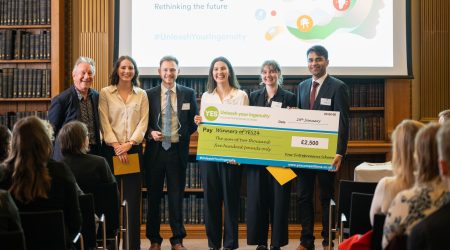

Dr Clare Stevenson and Leah Milner-Campbell have led an innovative BBSRC-funded project, cultivating a Neuroinclusive environment for staff and students
Unlocking Nature’s Diversity is the John Innes Centre’s ethos and research statement. Neurodiversity adds value to social environments in the same way that biodiversity enriches our ecosystems. The unique insights Neurodivergent individuals can bring to a research environment include innovative problem solving, excellent pattern recognition, and increased spatial thinking.
Dr Stevenson, Head of Science Coordination and Research Culture, highlighted: “We all bring our own strengths to a team. When everyone has the psychological safety and trust to bring their real self to work, it makes us all stronger.”
At least 20% of the population are thought to be Neurodivergent, meaning their cognition differs from what is considered ‘Neurotypical’ in society. The actual number is likely to be far higher due to people masking or being unaware of their own neurotype. Studies think the figure is also likely to be higher in science research environments.
A seminar on Neurodiversity was held at JIC in 2022, organised by the staff-led Accessibility Advocates group, where Professor Graham Moore FRS, JIC Director, spoke about his dyslexia. The conversations this ignited inspired Dr Stevenson to apply for a BBSRC Connecting Cultures grant. She was successful, and the landmark project began, with the aim of establishing Neuroinclusive best practice principles for research institutes, and to share learning with other BBSRC institutions. In July 2024, Leah Milner-Campbell joined JIC as Neurodiversity project officer to provide her wealth of expertise.
Neuroinclusive building blocks
To foster an inclusive environment, and to value diverse ways of thinking, the project focussed on training, awareness raising, and building networks. While plans for training initially involved external resources, Leah transformed these aspirations into an initiative that has given the project a strong legacy. Bespoke e-learning modules were created, featuring 24 staff and students. The training is an accessible and impactful learning experience that resonates within research environments. More than 600 people have engaged with the e-learning so far, from every BBSRC institute as well as colleagues at BBSRC. Leah also delivered bespoke training sessions for Neurodivergent individuals, allies, and managers at seven BBSRC-funded institutes.
Eight targeted parenting webinars were hosted across BBSRC institutes, to support parents of Neurodivergent children. 86% of parents who attended reported positive workplace changes following this series.
Dr Clare Stevenson and Leah Milner-Campbell
Awareness forms an essential part of cultivating a Neuroinclusive environment. A series of blogs were published covering topics from Tourette syndrome to intersectionality. JIC also held Neurodiversity events, including one on Neuroinclusive communications, alongside a new guide for staff.
Although the project officially ended in 2025, work is continuing to share the resources more widely, embed the learning, train Neurodiversity champions, and form networks of support and collaborations to build on the early success.
Dr Lionel Hill, metabolite service manager, said: “Taking part in the Neurodiversity e-learning was one of the most emotional and rewarding things I’ve done at JIC. It emphasised that we value one another with all our differences. My challenges aren’t half as challenging when I’m among friends.”
Leah Milner-Campbell, Neurodiversity project officer, said: “We have a way to go to make the world fair and equitable, but by embedding structural change and shifting perspectives away from a Neurotypical lens, we can create a research environment where Neurodivergent individuals can thrive.”
75% of e-learning participants had never done any Neurodiversity training before this course. After participating in training:
- Neurodivergent participants felt 74% more confident advocating for their needs at work
- Overall, participants felt their understanding of Neurodiversity increased by 53%
- Managers felt 33% more confident managing someone with a different neurotype to their own
The e-learning courses are available for everyone working at BBSRC institutes. However, if you are interested in accessing them from any other relevant organisation, please find more information here or email: clare.stevenson@jic.ac.uk