
Dr Kelsey J.R.P. Byers
Group Leader Building Robustness in Crops (BRiC), Harnessing Biosynthesis for Sustainable Food and Health (HBio)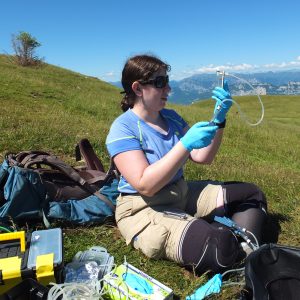
How does floral scent influence the evolution of flowering plants?
The vast majority of flowering plants rely on animal pollination to spread their pollen to other individuals of the same species.
How do plants attract pollinators, and how do they make sure their pollen gets to the correct species?
Flowers use many traits to influence animal pollinator visitation, including colour, shape, and scent. By making sure that the “right” pollinators visit in the right way, plants can ensure that their pollen is successfully transferred.
The Byers Group studies the evolution and diversification of floral scent at a wide range of scales, from genus-wide evolutionary patterns (lots of species) to floral scent evolution of pairs of species with different pollination systems (e.g. hummingbird versus bumblebee).
To further knowledge in this topic, they use approaches ranging from genetic mapping and manipulation of floral scent genes through to behavioural experiments with large plant arrays in greenhouse conditions.
They are also investigating how floral scent genes evolve in natural populations. At present research focuses primarily on monkeyflowers in the genus Mimulus (also known as Diplacus and Erythranthe), a developing model system in evolutionary biology.
Work on the fragrant orchid genus Gymnadenia focuses on the integration of different floral traits (morphology, color, pigments, scent) in hybrids between two very distinct species, as well as how the parent species and hybrids will respond to global change and what reproductive barriers prevent hybrids from being more common in the population.
The Byers Group also collaborates with Prof. Steve Penfield and Dr. Rachel Wells to investigate the production of floral scent in cultivated Brassica napus (oilseed rape) and its genetic basis.
Selected Publications
-
Neequaye M, Kellenberger R, Collier R, Paajanen P, Antoniou-Kourounioti R, Wenzell K, Hill L, Schlueter P, Byers K, Gunn H (2025)Pollinator-relevant floral traits impact bidirectional hybridisation in the orchid genus Gymnadenia
-
Wenzell KE, Neequaye M, Paajanen P, Byers K (2024)Within-species floral evolution reveals convergence in adaptive walks during incipient pollinator shift
-
Byers K (2021)As if they discovered it by the scent: improving our understanding of the chemical ecology, evolution, and genetics of floral scent and its role in pollinationAmerican Journal of Botany (108)
Opportunities
Informal enquiries to join the Byers group are welcome.