Symbiotic partner-swapping or long-term fidelity? The secrets of partnership success between beetles and bacteria
Some insects and microbes develop symbiotic partnerships, which become so interdependent that they can no longer survive without each other. But how specific are these heritable symbioses? Is it possible for the same species of bacteria to flourish across different species of insect hosts, or are these partnerships more fixed, honed over millions of years of evolution?
That was the fundamental research question addressed by new John Innes Centre Group Leader Dr Hassan Salem, his postdoctoral mentee, Dr. Inès Pons, and other colleagues at the Max Plank Institute for Biology, Tübingen, using tortoise beetles as a research model.
Tortoise beetles have developed their own symbiotic relationships with the bacteria Stammera capleta over millions of years, so much so that they now require some of them to digest their food. This is similar to how the microbes that live in the human digestive system are vital to our health.
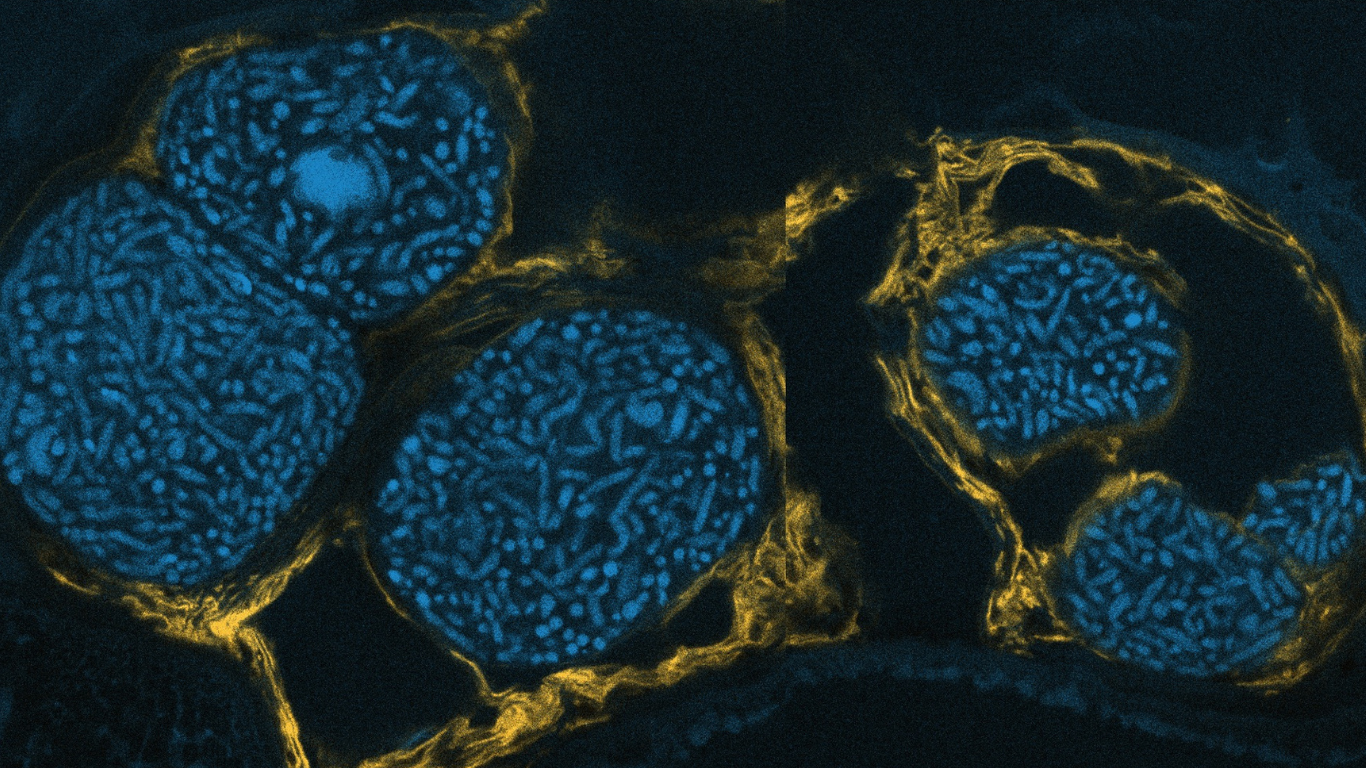
These partnerships are passed down from tortoise beetle parents to their offspring in an unusual way; S. capleta has a small genome and is passed from mother tortoise beetle to offspring via special sphere-like structures attached to the beetle eggs.
This makes the species the perfect subject of this research, to test whether these bacterial partners can be swapped, and what the effects are.
Using these structures as vehicles to swap bacteria between different beetle species, researchers found that bacteria from one beetle species can live inside another species’ digestive organs, but there is a sliding scale of success, dependent on how closely related the bacteria is to the original selection.
Bacteria from very different species triggered stronger immune system and metabolic responses in the young beetle and only partly supported normal development. Bacteria from closely related species behaved more like the original strain and helped the beetle develop normally. However, all of the newly introduced bacteria failed to be passed on to the next generation.
The results, which appear in Nature Communications, show that while some flexibility is possible in these examples of mutualism, highly specific, ancient biological partnerships are reinforced through partner recognition, transmission bottlenecks (where only some partnerships pass down to the next generation), and competition-based selection.
Dr Inès Pons-Guillouard was first author of this paper, and a postdoctoral mentee in Dr Salem’s lab. She said: “What surprised me most during this work is that it is possible to experimentally exchange symbionts associated with their hosts over the last 62 million years.
“This study model is remarkable because it opens exciting new avenues for understanding how such long-term partnerships are maintained and allows us to explore the extent of reciprocal coadaptation between hosts and their symbionts.”
These findings contribute to and validate a wider understanding of how specific gut microbes can be, with potential relevance across other species including humans.
Dr Salem, JIC group leader and senior author on the paper, said: “This exciting paper would not have been possible without the dedication and creativity of Dr Pons-Guillouard and the expert technical support of Christiane Emmerich, my group’s laboratory manager (who has also recently moved to the Norwich Research Park to work across JIC and TSL). Together, their skills synergised to overcome the challenges of such delicate and novel work.
“While in this work we studied a single clade of insects, exploring ways we could expand our research to include additional insect families would provide an important opportunity to test how broadly these patterns apply across the invertebrate world.”
There are 3,000 tortoise beetle species, and both the adults and larvae of some species are destructive to garden plants and crops such as sweet potatoes.
Fidelity in co-diversified symbiosis was published in Nature Communications.
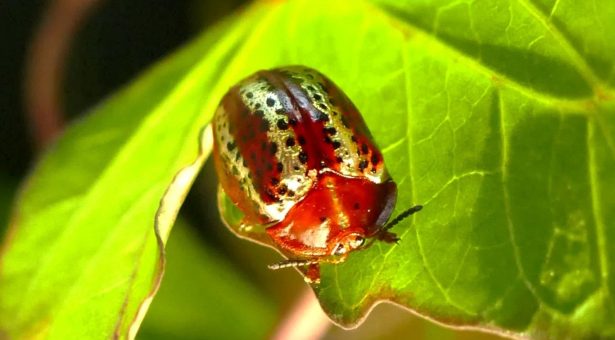
Image of tortoise beetle – Credit: Dr. Inès Pons