Sugar beet, oilseed rape, tomatoes and dandelions: four precision breeding projects win major funding to support UK agriculture

The John Innes Centre and its industrial and academic partners have been awarded UK Government funding to help deliver four ambitious projects that unleash the potential of precision breeding.
The Defra Farming Innovation Programme funding, delivered in partnership with Innovate UK, will enable the research-industry collaborations to develop sustainable new crops, open new markets, and support farmers by harnessing precision breeding techniques. At least £21.5m in new funding will back 15 innovation projects across England and Wales to help farms cut emissions, strengthen resilience, and boost productivity.
The use of precision breeding techniques, such as gene editing, to bring foods to market has been enabled by the UK Government’s Genetic Technology (Precision Breeding) Act 2023 which now covers this technology in England.
As a hub of excellence in this fast-developing area of crop science, the John Innes Centre, along with its extensive network of academic, agricultural and industrial partners, is seizing the opportunities for innovative biotechnology and farming solutions.
The successful projects involving John Innes Centre research cover diverse agricultural, horticultural, and biotechnology priorities.
Two will assist farmers facing major disease challenges growing the versatile commercial crops oilseed rape and sugar beet. Both these vital break crops are under threat from pests and pathogens, with farmers in urgent need of sustainable solutions following the withdrawal of environmentally damaging chemical controls.
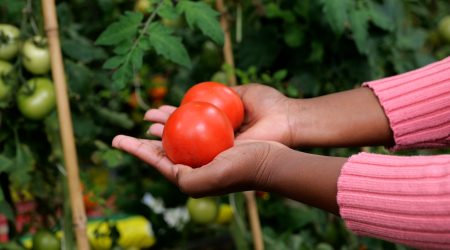
One exciting project will help to bring gene-edited Vitamin D3-enriched tomatoes to market for UK consumers, while another, an innovative biotech project, will use gene editing techniques to engineer dandelions to provide a sustainable source of rubber produced in the UK, using aeroponic (without soil) cultivation in indoor farms.
Professor Cristóbal Uauy, Director of the John Innes Centre, welcomed the announcement by Defra: “We are delighted to be partners in four of the projects chosen in the Farming Innovation Programme precision breeding initiative. The fact that our scientists and their industry partners have performed so strongly in this funding round is an endorsement of the John Innes Centre’s value as a hub of precision breeding expertise and a national capability supported by the BBSRC,” he said.
“The four projects, all quite different and on different crops, reflect the UK’s ambition to leverage new precision breeding technology for rapid crop improvement and innovation. With these enterprises we will help protect two major agricultural crops from damaging diseases, enhance the nutritional content of the world’s leading horticultural crop, tomato, while supporting an agritech project involving a completely new UK crop, dandelion. While the science itself is fascinating, the real-world impact these innovations could have on society, agriculture and farmers cannot be underestimated,” he added.
The Farming Innovation Programme is part of Defra’s investment in innovation, research, and development with an aim of using science to develop sustainable solutions for the practical challenges in agriculture and horticulture. The programme is delivered in partnership with Innovate UK, part of UK Research and Innovation (UKRI).
Successful projects receive Defra grant funding to cover a percentage of the eligible costs with the remaining balance funded by the organisations and industry partners involved.
Farming Minister Dame Angela Eagle said: “Innovation is central to a more productive, resilient farming sector. This funding will back new ideas farmers can use on the ground to cut methane and fertiliser-related emissions, strengthen crop resilience and improve nutrition.”
The four successful projects in the precision breeding competition which feature the John Innes Centre and partners are:
Scaling Gene Editing Induced Gene Silencing for Virus Yellows Resistance in Sugar Beet
This project, worth £1.7m over three years, is a partnership between the group of Professor Steven Penfield at the John Innes Centre, British Sugar, and Tropic Biosciences based at Norwich Research Park. The project will use gene editing technology to build genetic resistance in the sugar beet crop to virus yellows disease, described as an ‘existential threat’ to production and calculated as causing 25 per cent yield losses at a cost of £43m to growers.
Professor Penfield said: “This welcome investment will help us to apply our precision breeding expertise in protecting sugar beet, which is so critical as a break crop, a source of sustainable fuels and a key ingredient in a future, greener biotech economy.”
Dan Green, British Sugar Agriculture Director, said: “We are delighted to receive this additional funding from the UK Government. It is a testament to the engagement and dedication of our project team and partners who have worked on this project over the last two years. This funding will enable the team to continue progressing their pioneering work towards protecting the sugar beet crop from virus yellows disease, and potentially other crop diseases in the future.”
Light Leaf Spot Enhancing Resistance and Reducing Susceptibility with Editing (LLS Erased)
This £2.5m three-year collaboration includes researchers in the group of Dr Rachel Wells at the John Innes Centre, researchers at the University of Hertfordshire, crop-breeders, and farmers. The project will use gene editing to build resistance against several damaging diseases of oilseed rape including light leaf spot, a disease that cost growers an estimated £300m in 2022.
LLS-Erased project technical lead, Dr Wells, said: “I am excited to move our resistant plant material from the laboratory to field scale trials to see how it performs in a real-world setting.”
Project lead Tom Allen-Stevens of BOFIN (British On-Farm Innovation Network) said: “This project is game-changing for farmers. It will put precision-bred oilseed rape technology on to their farms for the first time across Europe.”
The collaboration includes specialist gene editing company Cibus, whose Rapid Trait Development System™ (RTDS®) enables precise genetic edits to be introduced directly into elite OSR breeding lines, significantly shortening the time needed to bring new traits to growers.
Cibus Senior Vice President of International Development, Tony Moran, said: “Cibus is delighted to have the opportunity to collaborate with a strong team to demonstrate the potential of gene editing in combatting a significant disease of OSR and delivering benefits to farmers in the UK and beyond.”
Sunshine Tomatoes: a farming future through precision breeding
This £1.1m three-year project aims to commercialise the Sunshine Tomato, a gene edited vitamin enriched tomato that addresses the critical global health challenge of vitamin D deficiency. The tomato, produced by the group of Professor Cathie Martin at the John Innes Centre, is set to become one of the first food crops approved under the UK’s precision breeding legislation. This latest project will help to ensure that consumers will reap the benefits with new products planned, including fresh tomatoes, sun-dried tomatoes, and plant-derived vitamin D supplements. The project also receives a financial contribution from John Innes Enterprises, the commercial arm of the John Innes Centre.
Professor Martin said: “The DEFRA/Innovate UK funding recognises the significance and potential of our achievements so far, in bringing the vitamin D3 gene edited tomato to human trials. Additionally, the decision of John Innes Enterprises to support this project will give flexibility in product development and allow healthier, affordable products to be developed to meet consumer demand. We hope that this will be a model for other research institutions to translate their strategic research innovations into products that consumers clearly want.”
Dr Jonathan Clarke, on behalf of John Innes Enterprises, said: “This innovative project aims to show that by using gene editing we can improve the nutritional composition of a staple, widely consumed horticultural crop as part of a longer-term strategy to improve human health.”
QuBOOSTR – Quality Bioengineering for Optimised Output & Sustainable Technologies in Rubber producing crops
This £2.4m project brings together Norwich Research Park-based startup company QuberTech, the John Innes Centre and its Germplasm Resources Unit, and LettUsGrow, a specialist in aeroponic indoor cultivation. This consortium will precision breed dandelions, which naturally produce latex/rubber in their root system, so that supply is optimised using aeroponic farming systems. Dandelions produce levels of latex in their roots that, historically, were seen as too low to be commercially viable and environmentally sustainable. However, this innovation offers a sustainable UK-based supply of a valuable global commodity which is at risk due to climate change and supply chain vulnerabilities.
Dr Noam Chayut, who manages the BBSRC-funded national capability Germplasm Resources Unit at the John Innes Centre, said: “The GRU legacy focus has been on broadening the diversity of UK strategic arable crops such as wheat and peas. We recently included underutilized and novel opportunity crops in our work portfolio aiming to diversify the future UK farming industries. This consortium is testimony to the trust of industry and government in this transformative vision. We have been working to source dandelions from partners around the world, building a resource from which we can choose varieties, most suited to rubber production. This resource will enable us to use gene editing and analytical tools to domesticate the plants and optimize them to produce a higher-grade product in greater quantities.”
Dr Neil Clelland, Co-Founder and CBO of lead partner QuberTech, said: “This project brings together a powerful combination of expertise, with the John Innes Centre’s world leading plant science, LettUs Grow’s advanced controlled environment growing systems, and QuberTech’s track record in gene editing and translating innovation to real-world applications. This grant will fully support QuberTech’s technical and commercial milestones, enabling us to build a new, domestic rubber supply that strengthens UK resilience, supports sustainable agriculture, and demonstrates how novel precision bred crops can deliver real economic and environmental benefits.”
Jack Farmer, Co-Founder and CSO of LettUs Grow, said: “LettUs Grow are very excited to commence this Innovate UK project, using our unique Aeroponic Rolling Bench technology to support Qubertech in their mission to boost resilience of the global rubber supply. By boosting crop performance and enabling clean and easy access to the crop roots, we believe this exciting R&D could further expand the market for high-tech glasshouse operators worldwide.”
Precision breeding describes a range of technologies, such as gene editing, that can make the same type of genetic changes as traditional breeding but in a more efficient and targeted way. It can deliver disease resistance, climate resilience, and better nutrition without adding genes from other species. This precision breeding competition is the first bespoke competition of its kind in this area.
Dr Stella Peace, Managing Director at Innovate UK, said: “Working alongside Defra, Innovate UK is ensuring precision breeding and low emission technologies move swiftly from research into real-world use, enabling farmers and agribusinesses to grow, compete and unlock new economic opportunities across the UK’s food and farming sector.”