
New group leader outlines big, broad, shared vision
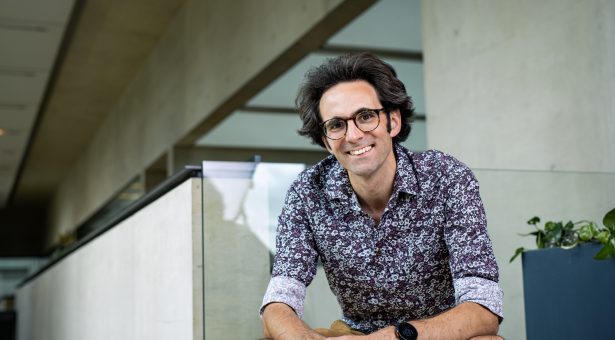
Dr Chris Whitewoods, a specialist in leaf development, returns to the John Innes Centre as a tenure track group leader in 2026.
Previously, Dr Whitewoods spent six years at the John Innes Centre as a post-doctoral researcher where he developed the carnivorous plant Utricularia gibba as a model organism to study the evolution of complex leaf shapes.
After starting his own lab in 2021 at the Sainsbury Laboratory, Cambridge University, his research investigates how the internal structure of leaves is patterned.
Dr Whitewoods’ group combines the use of genetic experiments and developmental analysis in plants with computational modelling and image analysis to explore how the inside of leaves form. He will take up his post in April 2026.
“The breadth of exciting science at the John Innes Centre is a huge draw, as are the world-leading resources for plant growth and imaging,” he said.
“I am looking forward to all the conversations and interactions with people across plant and microbial science. I hope that this will allow me to collaborate and address bigger and broader questions than I would be able to elsewhere,” he added.
The simple and flat surface of leaves conceals hidden complexity. Inside are several cell layers with two main types of photosynthetic cells surrounded by a complex network of intercellular air spaces. The position and shape of cells and air spaces are precisely patterned in three dimensions and change in response to the environment.
At the John Innes Centre, the Whitewoods group will use recently discovered mutant plants to explore the specialised functions of the two types of photosynthetic cells.
The group’s interest in the internal structure of leaves chimes with existing research at the John Innes Centre. This includes work on stem elongation and leaf shape as well as computer-aided investigations into how cells interact to generate 3D forms we see in leaves. Further potential crossovers exist with groups working in metabolism, including starch synthesis.
This exploration of the links between leaf structure and leaf function may contribute to improved crops, says Dr Whitewoods.
“Perhaps we can ultimately generate leaves with internal structures that allow higher rates of photosynthesis or are better adapted to a changing climate.”
Tenure track is part of a structured career pathway towards becoming a permanent or tenured group leader. Whatever discoveries lie ahead for the group in the coming years, they are best enjoyed as a shared experience, says Dr Whitewoods.
“I love helping the people in my lab grow as scientists. The moment someone comes to you with an unexpected result or a new idea that you had never thought of before is always exciting. Working in a team to do something big together is always a joy,” he said.
Director of the John Innes Centre Professor Cristobal Uauy said: “We look forward to welcoming Dr Whitewoods as an inspirational new addition to our vibrant research community. His work has great synergy with our existing research and holds promise for exciting new discoveries that deepen our understanding of leaf structure and can be applied to crop improvement.”