
Battling crop diseases without borders
How a research community maintains global defences against wheat rusts
Dr Zennah Kosgey, Senior Researcher at the Kenya Agricultural and Livestock Research Institute (KARLO) is dressed in white overalls despite the warm sunshine as she walks past small square plots of wheat plants, pausing occasionally to check for signs of disease.
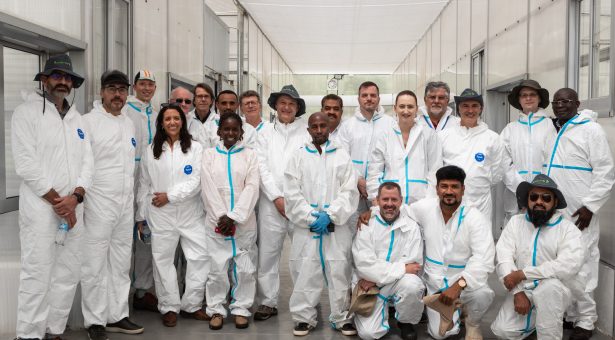
Today Zennah is joined in the field by 60 researchers from across the world. They have travelled to Njoro, Kenya, for the past 15 years to study a disease that can spread like wildfire through the field: wheat rust.
Wheat rusts have long threatened wheat harvests, leading to crop failures and famine throughout history. In more recent times, the introduction of rust resistant varieties was a cornerstone of the Green Revolution in the mid-20th century, that protected food and economic security for billions of people globally.
Without rust-resistant wheat varieties, this disease spreads rapidly on the wind across thousands of kilometres, causing enormous losses unless farmers regularly spray expensive and environmentally damaging fungicides.
These fungicides can also become less effective over time as the rust pathogen becomes tolerant to its effects, meaning the best defence against rust infection is to breed innately resistant wheat varieties that negate the need for fungicides. However, maintaining the resilience of these cultivars in the field is an ongoing challenge, as the pathogen evolves. It is a race against a formidable foe.
“The pathogen keeps mutating,” says Dr Kosgey, “so you don’t know what to expect next year.”
Like other infectious diseases, rusts are constantly changing and sometimes this results in a new strain that can overcome resistance, infecting plants that were previously protected. For instance, the Ug99 stem rust race detected in Uganda in 1998 overcame a resistance gene called Sr31, causing near complete harvest losses, and has now spread to 14 countries. Before this, Sr31 was one of the most widely deployed stem rust resistance genes globally, first transferred to wheat in the 1940s, and later bred into thousands of commercial varieties. With the arrival of Ug99, around 80% of the world’s wheat varieties in the early 2000s were suddenly susceptible to stem rust.
It is not possible to stop races like this from developing, but by detecting them early, we can develop control strategies to limit further spread and protect farmers — and this is exactly what the Disease Early Warning Advisory System (DEWAS) project was created to do. DEWAS is one of the world’s largest crop pathogen surveillance and advisory systems, protecting wheat productivity in food vulnerable areas of East Africa and South Asia.
https://youtu.be/OGdEQJRJp5I
How does DEWAS work?
There are several components that are required in the DEWAS project to safeguard wheat from largescale rust outbreaks. One is rust pathologists, field researchers who travel across wheat growing regions, scouring farmers’ fields looking for signs of rust infection. Collecting and identifying these rust samples helps record how different strains are spreading on the wind to new areas.
Professor Diane Saunders, group leader at the John Innes Centre, has long been involved with this programme, working closely with international collaborators to integrate the MARPLE diagnostics system into DEWAS to provide near real-time genetic detection of wheat rust strains across East Africa and South Asia. “Knowing exactly which wheat rust strain is present in a farmer’s field is critical information that helps tailor guidance within the early warning system and provide more effective control of disease outbreaks,” commented Professor Saunders.
Reflecting on the DEWAS programme, Professor Robert Park of Sydney University said: “I don’t know of any other system like it, integrating on the ground surveillance, through disease modelling and prediction of spread on to looking at genetic analysis of the pathogen to ground truth what those models are predicting for impact. It’s impressive and I haven’t seen anything like it.”
Beyond disease diagnostics, weather-based disease forecast models form another vital part of the DEWAS system, working with real-world data to predict where rust strains might shift to in the future.
Finally, researchers from around the world can bring their resistant varieties to locations like Njoro, Kenya, to trial their cultivars in a cocktail of the deadliest rust strains to learn how they will cope before the new spores arrive.
“Over the last decade we have come to Njoro to train the next generation of scientists so that they can learn from each other,” said Professor Maricelis Acevedo of Cornell University. “We train the national programmes from Africa and from Asia, so they can take the knowledge back home.”
These steps allow researchers to understand the risks in advance of a new ‘incursion’ event, when a pathogen strain arrives at a new location. Predictive forecasts can suggest when these threats might arrive and where, allowing local teams to control the initial infections before they spread widely. But preventing the spread of rusts is something that cannot be done in isolation.
“These diseases are wind-borne and so they don’t stop at borders,” said Professor Park, “so you can have a country working very diligently but unless you are working with other countries, the value of the work is diminished, and the challenges are much greater. Having a connected network of people is absolutely vital in dealing with transnational pathogens.”
The DEWAS project, led by CIMMYT and Cornell University with funding from the Gates Foundation and FCDO UK, was designed to not only study rust, but also to connect researchers across countries to create an international rust response system with the cover and efficiency required to rapidly respond to new and emerging threats.
“The major success of this group is the collaboration,” said Dr Neil Hausmann of the Gates Foundation. “There is strong trust across the 15 countries involved and we’ve had ministers of agriculture visit who thank us for this programme specifically.”
DEWAS’ impact and future
One example of the effectiveness of this system was demonstrated in November 2023. Researchers in Nepal detected an unusual occurrence of stem rust. Through the DEWAS collaboration, they immediately shared these samples with researchers at The Global Rust Reference Center (GRRC) in Denmark, who confirmed new incursion events – Ug99 and two virulent Clade IV strains of stem rust had entered Nepal.
DEWAS partners from the University of Cambridge and UK Met Office used forecasting models to predict how these new strains could spread, showing likely spread across Nepal and even into Bhutan. Mobilising enhanced surveillance efforts within DEWAS, these predictions were rapidly confirmed, giving both countries the time needed to respond before the rust could develop and spread. Such events continue to remind us of the importance of the DEWAS system in guarding wheat productivity from the shifty nature of these deadly pathogens.
“The threats are real and increasing with climate change,” said Dr Hausmann, “and the need for coordinated action is higher than ever.”
However, the value of these systems can be easily overlooked because when operating effectively the damage of rust outbreaks can be avoided or diminished so that harvests are maintained. It is only in the absence of these systems that their impact is most apparent; undetected new pathogen strains can spread rapidly and large-scale disease outbreaks can occur.
Although the future of DEWAS remains uncertain beyond current funding until early 2026, there is no doubt that the monumental efforts of the international DEWAS community have created a remarkable system that is capable of finally curtailing the long-standing devastation caused by wheat rust pathogens.