A Year in Industry – a world of opportunities
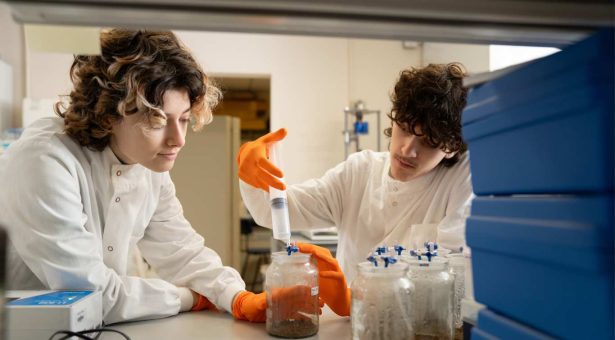
Over the last 12 years, the John Innes Centre has welcomed 35 Year in Industry students into our laboratories. The programme provides a great opportunity for undergraduate students to gain practical scientific experience and to work in a research environment.
This year Dr Maria Hernandez-Soriano and Dr Simon Griffiths hosted Amelia Lyons, a Biology undergraduate student from the University of York.
During her degree, Amelia has focused on ecology alongside genomics, so when a Year in Industry opportunity arose at the John Innes Centre it was the perfect placement. Amelia joined Dr Hernandez-Soriano’s WISH-ROOTS project which aims to enhance the potential beneficial effects of wheat cultivation on soil health and to identify wheat varieties that support more sustainable land use. This project’s focus on not only plants, but soil and microbes too, added to the serendipity of this placement for Amelia, as a university module on plant-microbe interactions and the soil nutrient cycle had already piqued her interest. This, alongside JIC’s commitment to equality and diversity, solidified her aspiration to spend the year with the JIC team.
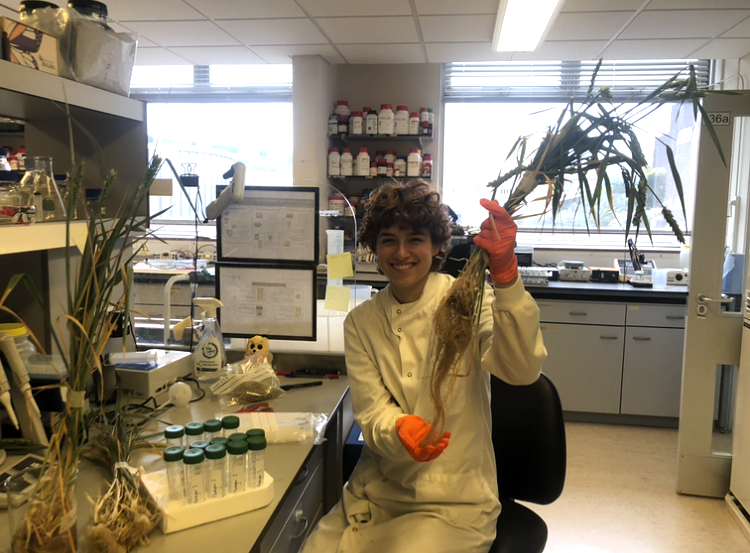
And the institute has benefitted too. Amelia’s support has helped broaden the scope of the WISH-ROOTS research, as she has been investigating the impact of wheat genotypes on the soil microbiome and root architecture across the plant’s lifecycle. This has involved exploring traits to decrease carbon loss and enhance carbon storage in crops and potentially improve soil structure through root morphological traits.
Amelia most enjoyed seeing her work flourish from the experimental planning stages into real life. She took part in testing seeds at germination, all the way through to seeing the racking and drilling at the Dorothea de Winton field station, watching her tiny seedlings grow into full plants — a far cry from the smaller scale experiments she was used to at university.
Amelia even supported a T level placement student, Lewis, working with him in the lab on seed nitrogen content analysis and soil aggregation, highlighting to her just how much she had already learnt about the project after only a few months at the institute.
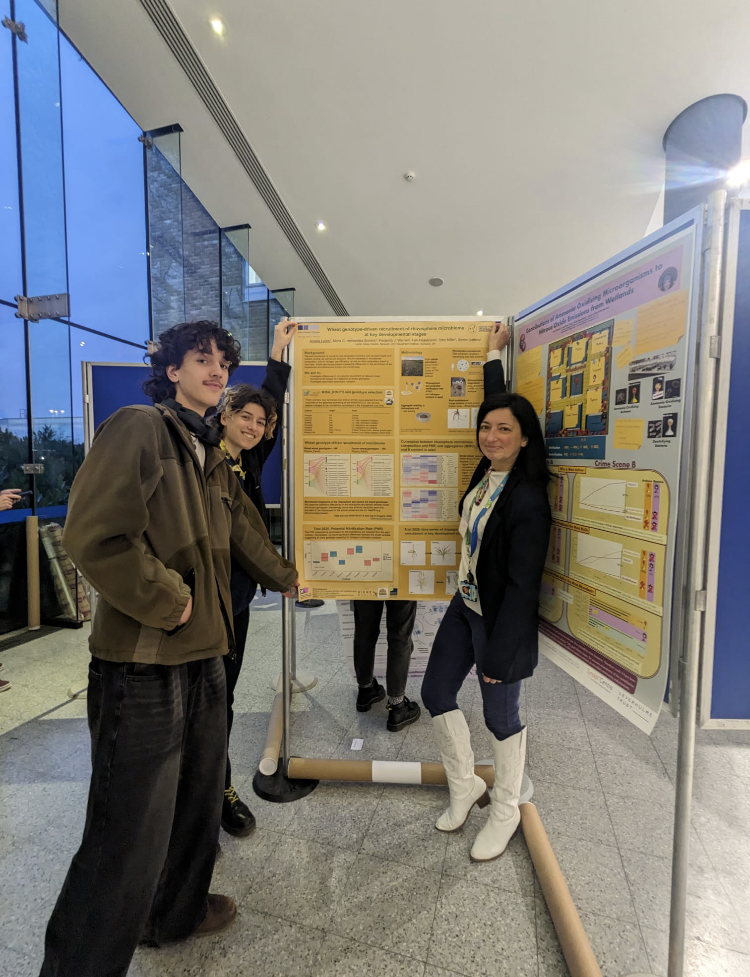
During her placement Amelia seized the opportunity to present a poster and talk at the inaugural Centre for Microbial Interactions (CMI) Conference – an impressive achievement for an undergraduate student. Despite it feeling overwhelming, Amelia embraced the experience and ended up feeling proud of being the expert on the work she was presenting: “Everything just clicked into place.”
She was also selected to attend a workshop in Greece on biological nitrification inhibition organised by a European Cooperation in Science and Technology (COST) action. This workshop enabled Amelia to interact with other scientists in the field at different stages in their careers, attend lectures delivered by experts, and receive microbiology and bioinformatics training.
Amelia describes her Year in Industry as an eye-opener, showing her first-hand what being part of a research institute can be: “There’s so much behind the scenes that gets the science out into the scientific community and the public, and that is so interesting to see. I would recommend a Year in Industry at the John Innes Centre, as the environment is collaborative, with a high calibre of research, somehow maintaining the lively atmosphere of a university campus. I’m excited to be involved in writing a paper too; the work I’ve been doing is contributing to real life research and making a difference in the community.”
The independence and trust afforded to Amelia by Maria, as well as the extracurricular activities offered at the John Innes Centre, were particular highlights for her. For example, Amelia regularly attended the institute’s Friday Seminar series (a weekly programme of seminars with internationally eminent plant and microbial scientists). One seminar exploring embryo-endosperm communication in developing seeds has opened up a whole new world of botany for her.
Ultimately, involvement in the programme has confirmed to Amelia that she wants to pursue science beyond her undergraduate degree, and she is even considering returning to JIC to study for a PhD.
For Maria, this has been an equally enriching experience: “‘Mentoring a student at this stage is truly rewarding because they bring great enthusiasm, curiosity and commitment. It has been fulfilling to share my professional experience and help develop Amelia’s skills for her future career. She’s been a true team player, always engaged and keen to learn.”
The JIC Year in Industry Scheme is open to UK undergraduate students only. We are offering three funded places for the academic year 2026-27. Applications for the 2026 intake will open on 12 September 2025 and close on 6 October 2025.
For the academic year 2025/26, two placements will be funded by the John Innes Foundation.