
Professor Anne Osbourn
Group Leader Fellow of the Royal Society Harnessing Biosynthesis for Sustainable Food and Health (HBio)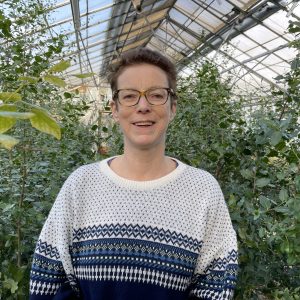
Anne investigates plant natural product biosynthesis.
Anne’s discovery that the genes for many of these pathways are organised in clusters in plant genomes like ‘beads on a string’ has greatly accelerated the ability to find new pathways and chemistries of potential importance for the development of drugs and other useful compounds.
She has also developed a synthetic biology platform for rapid gram-scale production, using triterpenes as an exemplar.
- Triterpene biosynthesis, enzyme and pathway discovery
- Genome mining for natural product pathways
- Production of natural products and analogs for drug and chemical discovery programmes
An important advance from their lab has been the discovery that genes for specialised metabolic pathways are organised in ‘operon-like’ clusters in plant genomes, a finding that has opened up new opportunities for pathway discovery through genome mining, metabolic engineering and synthetic biology.
Terpene pathway discovery, elucidation and engineering. The terpenes are one of the largest and most diverse classes of plant-derived natural products and have a wide range of applications in the agriculture, pharmaceutical, food and manufacturing industries. These compounds have a high degree of structural complexity, making them inaccessible to organic synthesis or classical combinatorial chemistry.
The lab have characterised an extensive set of genes and enzymes for triterpene biosynthesis and are using this toolkit to engineer structurally diverse molecules so that we can investigate the relationship between structure and function. They aim to create new methods, platforms and technologies for the rapid discovery, synthesis and modification of triterpenes that would not otherwise be accessible.
Operon-like gene clusters and synthetic traits. Plant genomes contain thousands of genes with predicted functions in secondary metabolism, but the metabolic diversity of plants remains largely unexplored. They are exploiting the discovery that genes for the synthesis of different classes of specialised metabolite are organised in ‘operon-like’ clusters in diverse plant species to discover new metabolic pathways and chemistries and to gain insights into plant genome structure, organization, regulation and evolution.
They are also using synthetic biology approaches for cluster engineering and to make functional synthetic clusters (potential ‘syntraits’).
In 2023 Anne Osbourn received the Novozymes Prize for her pioneering research.
In addition to the above, Anne developed and co-ordinate the Science, Art and Writing (SAW) Initiative, a cross-curricular science education outreach programme. Anne is also passionate about Popular Science Writing.
Selected Publications
-
Payet R, Houghton A, Aouidate A, Pham M, Casson R, Osbourn A (2025)A million shades of green: Understanding and harnessing plant metabolic diversityEMBO Journal
-
Martin LBB, Kikuchi S, Rejzek M, Owen C, Reed J, Orme A, Misra R, El-Demerdash A, Hill L, Hodgson H, Liu Y, Keasling JD, Field RA, Truman AW, Osbourn A (2024)Complete biosynthesis of the potent vaccine adjuvant QS-21.Nature chemical biologyPublisher's version: 1552-4450
-
Stephenson MJ,Osbourn A (2020)Making drugs out of sunlight and thin air: An emerging synergy of synthetic biology and natural product chemistryThe Biochemist (42 (4))
Opportunities
There are a number of different opportunities within the Anne Osbourn lab.
Writers and artists – are also very welcome to contact Anne Osbourn to explore opportunities for interdisciplinary interactions.
Send applications and enquiries to;
Professor Anne Osbourn
John Innes Centre
Norwich Research Park
Norwich
UK
NR4 7UH