Alumni stories: Dr Ruth Bryant, from plant breeding to crop protection – an insight into agriculture
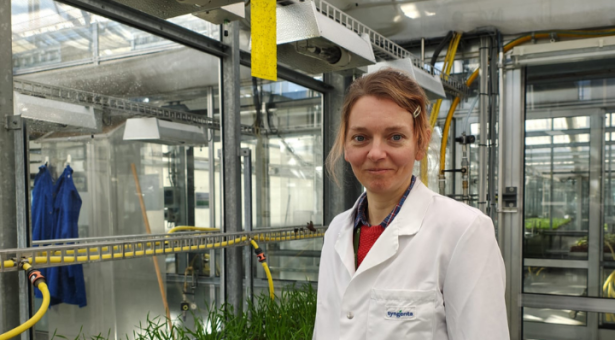
Ruth studied at the John Innes Centre from 2009 to 2013 after completing a Biology degree at the University of Manchester and working for the Food and Environment Research Agency. We spoke with Ruth about her love of plant pathology which has taken her career from Cereal Pathologist at RAGT to Disease Control Scientific Expert at Syngenta.
What brought you to the John Innes Centre?
Whilst working for the Food and Environment Research Agency from 2007-2009, I discovered a fondness for working with plant diseases. A PhD opportunity arose in Dr Chris Ridout’s lab at JIC which aligned perfectly with my interest in plant pathology. There was a particular buzz around the impact of climate change on plant diseases at this time, which inspired my research on yellow rust in wheat and climate change. Professor Cristóbal Uauy had just cloned Yr36 and demonstrated that this gene was temperature sensitive, prompting me to investigate the influence of temperature in yellow rust disease resistance.
What key skills did you gain from this?
As well as a greater understanding of plant pathology, I attribute my confidence as a presenter to my time at JIC. I went from being terrified of the idea of even giving a departmental seminar to winning a prize at a conference for the best talk! Now I quite enjoying presenting.
What was the highlight of your time at JIC?
A PhD at JIC isn’t just about education; it’s about introducing you to a range of opportunities. There were a variety of science communication events to get involved in, and I was even part of organising a student conference with friend and fellow student Nikolai Adamski. I remember these events fondly and loved having the chance to make connections across JIC and beyond.
What influence did your PhD have on your next career steps?
It was incredibly valuable. Whilst doing my PhD, I interacted with breeding companies who were interested in whether they could implement my research. These relationships helped familiarise me with the kinds of roles available in breeding and shaped my next steps.
Where did your career take you after your PhD?
I went on to work for RAGT as a plant pathologist, supporting the European breeding programmes through resistance advice. My favourite part of this role was leading a programme which introduced novel traits, ranging from disease resistance to yield. Understanding each country’s requirements and helping deliver traits to market was really rewarding.
What does your current role involve?
I’m now working for Syngenta, based in Switzerland. I’m still working in agriculture and on disease, but this time it’s in crop protection. A big part of my job is working on early-stage research projects on both biological and chemical fungicides. This involves understanding the active ingredient’s Mode of Action (MoA), its strengths and weaknesses, and the potential disease spectrum it can work against. The role is very varied and I’m still learning, which I really enjoy. I’ve had to get used to AI meaning ‘active ingredient’, not artificial intelligence! After working in breeding for over ten years, it was a difficult decision to change careers. However, this role has given me a whole new insight into agriculture.
What has been the proudest moment of your career so far?
My work on the novel traits programme at RAGT, where our team played a significant role in launching varieties of wheat which are more tolerant to barley yellow dwarf virus in the UK and France. It is extremely difficult for novel traits to be introduced in the breeding programme, as resistance traits can often have disadvantages elsewhere, so it was a very proud moment for all of us.
Do you have any advice for current staff and students?
JIC is so good at maintaining connections with other academics and with industry, so seize those opportunities to make connections while you are there. When you are looking forward to your next career steps, I would also say it is important to think about what motivates you. I was keen to push science discoveries into deliverables, so industry was best placed for me, but I still get to interact with JIC and other institutes so I don’t feel I’ve completely left academia.
What does the future hold for your career?
The potential for mainstream use of biologicals in field crops and being able to tie together breeding and crop protection to reduce plant disease is what I’m really excited about. My experience working with different plant varieties could be useful in understanding different responses to applied active ingredients. Biological crop protection isn’t straightforward so I’m passionate about understanding these varietal discrepancies and providing growers with our conclusions.