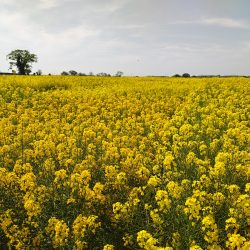
Photo: Darryl Playford
Field Experimentation Manager. Experimental plots of oilseed rape 2025. These were a diverse panel of 60 winter-type Brassica lines that were cultivated as part of a project to identify novel plant-based protein sources for the human diet. This diversity set included oilseed rape (Brassica napus), swede, and various fodder-type lines. Following harvest, the seeds were collected and analysed to determine their protein content.
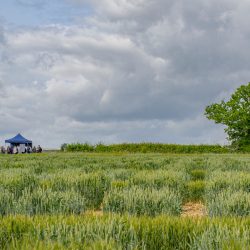
Photo: Amy Foster
Field/Photography Assistant: Experimental plots of wheat 2025. These were grown for the Germplasm Resource Unit for seed multiplication and phenotyping particularly for nutritional traits such as iron, zinc and grain protein content. The lines were generated by irradiation from the spring wheat cultivar ‘Paragon’
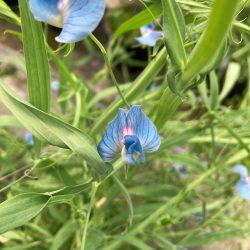
Photo: Jasmine Staples
Post Graduate Research Student. One of the grass peas from a diversity panel which is investigating more about grass peas including how its toxin beta-ODAP is made. The deep blue colour of its flower, with a section of white and pink at the base of its standard/banner petals, is the most common for grass pea, although you can also find pink and white flowers.
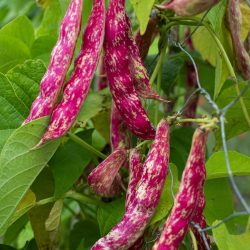
Photo: Amy Foster
Field/Photography Assistant. Pods of a climbing bean. In the UK, we love having baked beans on our spuds, but unfortunately, the common beans we eat (Phaseolus vulgaris) are not grown in UK fields and are imported. Beans are legume plants, which form a relationship with soil bacteria that supply the plants with atmospheric nitrogen, making them more agriculturally sustainable than other crop families. So, when you eat legumes, you contribute less to soil, air and water pollution.
This plant was grown by the Germplasm Resource Unit team, under their work theme of “Opportunity Crops,exploring ways to diversify UK agricultural production to support a more sustainable local economy.”
Photo: Phil Robinson
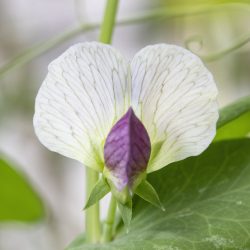
Scientific Photographer. One of the peas from a mapping population that has been used to aid in the identification and refinement of genetic loci responsible for improved nutritional, seed quality, agronomic and disease resistance traits at JIC.
This recombinant population was derived from a cross between genetically distant parents, Cameor; a French field pea variety and an accession from Ethiopia. These peas were domesticated independently of each other.
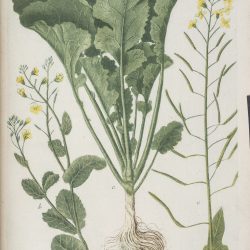
Brassicas. Weinmann, J. W. (1736-1748), Duidelyke vertoning Eeniger Duizend in alle Vier Waerelds Deelen… pl. 266. Courtesy of the John Innes Foundation. The Brassicas in this image (neapolitana and tuberosa) were printed in the late 1730s. They’re taken from a Dutch edition of Phytanthoza Iconographia by Weinmann, an apothecary whose interest in botany led him to create his own botanical garden in Regensberg in Bavaria.
Phytanthoza Iconographia featured over a thousand illustrations, representing several thousand different plants. They are early examples of colour mezzotint, a printing method producing painterly details. Weinmann struggled to retain artists, with a number of different artists contributing. Some were unfamiliar with botany, and as a result the work has been valued more for its aesthetic value than its scientific accuracy.
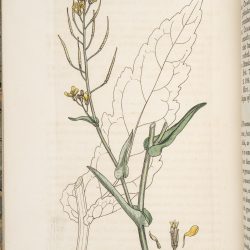
‘Brassica napus’. Sowerby, J. & Smith, J. E. (1810) English Botany, v.30, pl. 2146. Courtesy of the John Innes Foundation. This detailed illustration of Brassica napus appears in English Botany, the first detailed description of British flora to be published. Beginning in 1790, it took nearly 25 years for all 36 volumes to be completed. The set features 2592 plates representing all known British plants except fungi.
English Botany was a collaboration between artist James Sowerby and botanist James Edward Smith, who had met in Norwich. The work was Sowerby’s idea, and his illustrations were based on specimens he solicited from botanists across the country, with Smith contributing to the descriptions.
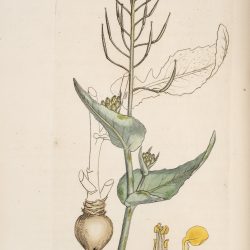
‘Brassica rapa’. Sowerby, J. & Smith, J. E. (1810) English Botany, v.31, pl. 2176. Courtesy of the John Innes Foundation. This detailed illustration of Brassica rapa appears in English Botany, the first detailed description of British flora to be published. Beginning in 1790, it took nearly 25 years for all 36 volumes to be completed. The set features 2592 plates representing all known British plants except fungi.
English Botany was a collaboration between artist James Sowerby and botanist James Edward Smith, who had met in Norwich. The work was Sowerby’s idea, and his illustrations were based on specimens he solicited from botanists across the country, with Smith contributing to the descriptions.
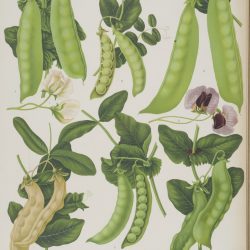
‘Peas’. Benary, E. (1882) Album Benary, Tab. xxvii. Courtesy of the John Innes Foundation. This colourful image of peas including ‘telephone (wrinkled) peas’ and ‘purple-podded peas’ comes from a 19th Century seed catalogue. Published by the German seed supplier Ernst Benary, the collected catalogues are known as the Album Benary, and its pages contain some of the most striking and sumptuous botanical illustrations of vegetables ever published.
As well as this important contribution to botanical art, the Benary company have a link to plant science and genetics. Archive evidence shows that the geneticist Gregor Mendel purchased seeds from the Benary company in the 1870s, and was an early supplier to the John Innes Horticultural Institution, a predecessor of the John Innes Centre.
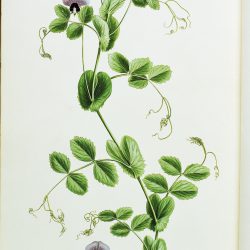
‘Pisum arvenses’. Sibthorp, J. & Smith, J. E. (1830) Flora Graeca, V.vii, pl. 687. Courtesy of the John Innes Foundation.
This image of Pisum arvenses or field pea is taken from the 10 volume Flora Graeca. Described as ‘the most costly and beautiful book devoted to any flora’, the large volumes capture nearly 1000 images depicting the plants of Greece and the eastern Mediterranean, printed using hand-coloured copper plates.
The Flora Graeca is based on information gathered by botanist John Sibthorp and artist Ferdinand Bauer, on expeditions in the late 18th Century. Due to Sibthorp’s death, production of the work was continued by James Edward Smith, founder of the Linnean Society, and later by John Lindley, both born in Norwich.
The high costs of production meant only 30 subscriptions were made for the first set, with only 25 of those produced. One of which is held in the John Innes Historical Collections.
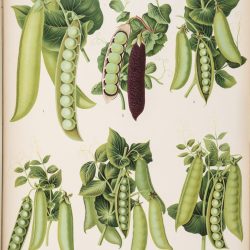
‘Sugar or edible-podded peas’. Benary, E. (1879) Album Benary, Tab. xxiii. Courtesy of the John Innes Foundation. This colourful image of ‘sugar or edible-podded peas’ comes from a 19th Century seed catalogue. Published by the German seed supplier Ernst Benary, the collected catalogues are known as the Album Benary, and its pages contain some of the most striking and sumptuous botanical illustrations of vegetables ever published.
Designed to appeal to potential clients across an international market, the crisp, bright images are said to have been drawn from life by Benary himself, though the colours have been exaggerated.
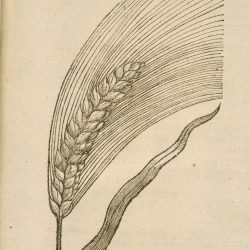
‘Bright wheat (Triticum lucidum)’, Gerard, J. & Johnson, T. (1636) The herbal or, Generall historie of plantes. P.67. Courtesy of the John Innes Foundation. This early 17th Century woodblock print of bright wheat is from a text known as Gerard’s Herball. First printed in 1597, it places illustrations and descriptions of the plants’ habitats, flowering habits and medicinal uses alongside anecdotes and literary quotations. Thanks to its use of the English vernacular, it became one of the most well known English herbals.
This later edition was revised and expanded by apothecary Thomas Johnson, who corrected some of Gerard’s inaccuracies and expanded the work with additional plants. This same printed image appears in the first version of the text where it is labelled as Flat Wheate (Triticum typhinum). It was made using an earlier woodblock, bought by Gerard from the famous Antwerp printing house of Christoph Plantin.
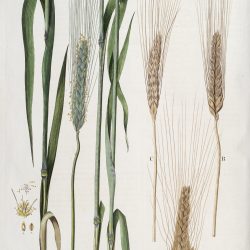
‘Triticum turgidum’, Krause, J. W. (1835) Abbildungen und Beschreibung aller bis jetzt bekannten Getreidearten, mit Angabe ihjrer Kultur und Nutzen. Vol.2 Tab.1. Courtesy of the John Innes Foundation. This detailed diagram of wheat is from an 1830s German scientific publication dedicated to describing the features, cultivation and benefits of cereals. The author, Johann Wilhelm Krause (1764-1842) was a German priest and botanist. His interest in agriculture led him to collect different types of cereals, many of which were not traditionally cultivated in Germany. This work helped to provide clarity and order within the fast-evolving field of agriculture in 19th century Germany.
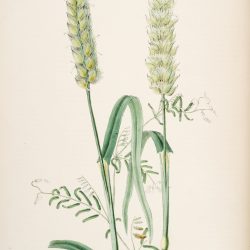
‘Triticum hybernum’, Burnett, M. A. (1842) Plantae utiliores; or, illustrations of useful plants employed in the arts and medicine. Vol 1. Courtesy of the John Innes Foundation. This image of wheat comes from a 19th century book called Plantae utiliores or ‘useful plants’. By placing illustrations alongside the known uses of the plants it echoes the long tradition of herbals. The illustrator and editor was Mary Ann Burnett (d.1856), a British botanist, whose brother Gilbert, provided some of the text. Not much is known of Mary’s life, though her brother was a surgeon and botanist based in London, and edited and published other botanical works.