Visit the BBSRC website (opens in a new window)

The John Innes Centre receives strategic funding from BBSRC

BBSRC News feed
John Innes Centre

Quick Links

Biotechnology and Biological Sciences Research Council

The John Innes Centre is one of eight institutes that receive strategic funding from the BBSRC. The institutes deliver innovative, world class bioscience research and training, leading to wealth and job creation, generating high returns for the UK economy. They have strong links with business, industry and the wider community, and support policy development.

The institutes' research underpins key sectors of the UK economy such as agriculture, bioenergy, biotechnology, food and drink and pharmaceuticals. In addition, the institutes maintain unique research facilities of national importance.

Download Advances

Download latest copy.
Advances reflects the originality of the science we do and
addresses the
interests of
our wide
stakeholder base.

Germplasm Resources Unit

The Germplasm Resources Unit provides a nationally unique resource, maintaining germplasm resources and associated information for the benefit of both JIC and the broader research community.

Economic Impact

Food Security - What Next?

John Innes Foundation

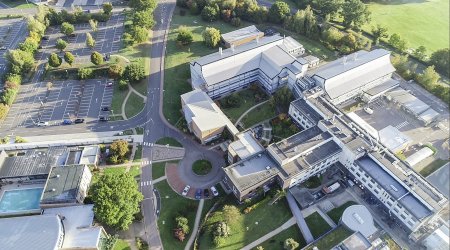
JIC is situated on the Norwich Research Park

JIC forms part of the
Norwich Research Park

Become a Friend of JIC

Find us on Facebook Follow us on Twitter Visit our YouTube channel

Welcome to the John Innes Centre, an independent, international centre of excellence in plant science and microbiology. Our mission is to generate knowledge of plants and microbes through innovative research, to train scientists for the future, to apply our knowledge to benefit agriculture, the environment, human health and well-being, and engage with policy makers and the public.

The John Innes Centre contributes over £170M annually to the UK economy, demonstrating the impact and relevance of the excellent scientific research we undertake, and validating the investment of public funding to support this (2008 data from an independent report by DTZ). An economic impact brochure highlights the key achievements of the institute during the 100 years of its existence, the impact of its science and how it has been of benefit to society.

News from JIC

Professors Mike Bevan and Mervyn Bibb

Royal Society elects two new Fellows from the John Innes Centre

May 2013

Two scientists from the John Innes Centre, Professors Mike Bevan and Mervyn Bibb, have been elected as Fellows of the Royal Society, the premier scientific accolade in the UK. Their breakthroughs in fundamental research have pioneered advances in antibiotic discovery and in crop improvement from which we all benefit.

Mervyn Bibb at a symposium in Madison in1978

Q&A: Professor Mervyn Bibb

May 2013

The enthusiasm of a school biology teacher helped fuel Professor Mervyn Bibb’s own curiosity. Find out more in this Q&A with the newly elected Fellow of the Royal Society

Professor Mike Bevan being awarded with the Rank Prize for Nutrition

Q&A: Professor Mike Bevan

May 2013

Newly elected Fellow of the Royal Society, Professor Mike Bevan, talks about his research, past present and future, in this Q&A.

More food and greener farming with specialised transporters for plants
May 2013
To grow more food more sustainably we need to make plants better at recruiting nutrients and water from soil to seed, according to 12 leading plant scientists writing in Nature.

Petal and leaf growth patterns

Hidden map in growing buds shown to control leaf and petal shape
May 2013
Why do rose petals have rounded ends while their leaves are more pointed?
In a study to be published in open access journal PLOS BiologyJohn Innes Centre and University of East Anglia scientists reveal that the shape of petals and leaves is controlled by a hidden map located within growing buds.

Beer brewed from Victorian barley variety
April 2013
For the first time in nearly a century drinkers will be able to taste beer made from Chevallier. Scientists at the John Innes Centre revived the classic heritage barley from the Victorian period, as it has historically produced good yields with valuable disease resistence.

JIC training to help scientists fight disease-causing bacteria
April 2013
Scientists from around the world will benefit from five days’ training at the John Innes Centre on bacteria that cause disease in economically important crops including maize, potato and apple.

Molecular microbiology department recruits new project leader
March 2013
The John Innes Centre’s molecular microbiology department has recruited a new project leader. Dr Barrie Wilkinson joins JIC from Cambridge drug discovery company Biotica, where he was vice president for research.

Related graph image

JIC researchers to assist with antibiotic discovery
March 2013
A screen developed by JIC researchers can be used to find new inhibitors of harmful bacteria, according to a paper published in PLOS ONE.  These new inhibitors have the potential to be developed as new antibiotics or herbicides. Such research is crucial at a time when drug companies are reducing their efforts in antibiotic discovery.

Major cash for ash
March 2013
Major funding from BBSRC will help scientists learn how the ash dieback fungus spread to the UK, how it causes such devastating disease, and how to restore our native ash population to health. A live Q&A about the research effort took place on Monday 11th March creating a resource of information on ash dieback. Visit the OpenAshDieBack website to see the Q&A in full.

EMBO Practical Course Logo

Multi-level Modelling of Morphogenesis
March 2013
The EMBO Practical Course in 'Multi-level Modelling of Morphogenisis' returns to Norwich's John Innes Centre 14th - 26th July 2013. Speakers from around the world will provide students with the theoretical background, tools and the hands-on methodology that are needed to enter this rapidly growing area of science. For more information, head to the course website.

€2.5M EU funding to explore the growth and evolution of carnivorous plants
February 2013
Professor Enrico Coen has been awarded €2.5M EU funding to explore the growth and evolution of carnivorous plants. Using 3D imaging techniques his research group have created an inside view of their remarkable leaf structures.

Growing talent – schools to provide vital knowledge for food security
February 2013
Sixth form students in Norfolk will take on the challenge of providing the first insights into how some plants resist a major wheat disease. They will work with scientists from the John Innes Centre on a project called “Supermodel fights famine” funded by the Royal Society and the British Society for Plant Pathology.

What makes flowers so beautiful?

What makes flowers so beautiful?
February 2013
Why are some leaves curly, others spiky, and others flat? Listen to the recent BBC radio discussion, Forum, in which  John Innes scientist professor Enrico Coen discusses these questions with New York photographer Andrew Zuckerman, and ecology professor Lars Chittka.

“Growing” medicines in plants requires new regulations

“Growing” medicines in plants requires new regulations
February 2013
New regulations for plant-made pharmaceuticals could help stimulate innovation in making cheaper vaccines, pharmaceuticals and organic plastics using plants.

More News...