
How research software engineers are bridging the gap between biology and computer science
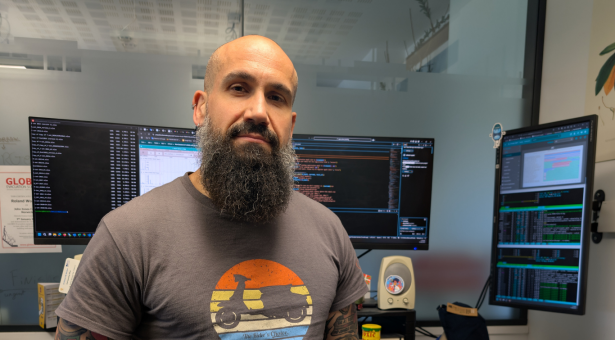
Miguel Gonzalez Sanchez looks back at his unconventional career path to becoming a research software engineer, and the skills he has developed that help support quality science with solid digital infrastructure. As part of his journey, he has been supported by the Technician Commitment Collaboration Fund and the RSE Society to deliver the RSEEE & WHPC Meeting 2026 which he reflects on here.
When I moved to the UK in 2017 to support my partner as she began her PhD at the John Innes Centre, I couldn’t speak a word of English so it felt like starting over. Despite my background in computing, customer service, and software development, if you had told me then that I would one day help lead a regional conference for Research Software Engineers at a world-leading science institute, I would never have believed you.
My first job in a new country was as a hospital porter at the Norfolk and Norwich University Hospitals NHS Foundation Trust. Around a year after moving to the UK, I joined the Norwich Bioscience Institutes (NBI) as a Desktop Support Engineer apprentice. Progressing from apprentice to Support Engineer, I then spent time as a Junior System Administrator in the Research Computing team and eventually found my place in the John Innes Centre’s informatics team.
Today, I work as a Research Software Engineer (RSE): a role that acts as a bridge between cutting-edge plant, microbial and computer science. Research depends on people who can connect disciplines, and technical professionals like RSEs contribute this to modern science. In my role, my customer service background has been just as valuable as my technical experience.
Understanding researchers’ needs and communicating complex solutions clearly is vital. RSE career journeys are varied, but what connects us is that we apply professional software engineering practices to research, helping make scientific outputs reliable, scalable and reproducible.
One benefit of having had an unconventional career path is that I value the power of networking and cross-disciplinary collaboration, which is why I chose to attend RSECon25, one of the leading RSE professional conferences promoting research excellence. Imposter syndrome has been a constant companion on my journey but, at that conference, I met scientists, engineers and technical specialists who had followed traditional academic paths working side-by-side with professionals from non-traditional backgrounds like mine. Learning that we were all facing the same challenges and sharing the same passion for improving research completely shifted my perspective. I came back determined to build that same sense of community and connection at the NBI.
This is what inspired me to lead the organisation of the RSEEE & WHPC Meeting – East Anglia 2026. Behind this intimidating acronym is a fantastic collaboration between the Research Software Engineering East of England (RSEEE) community and Women in High Performance Computing (WHPC). This partnership matters because we still have work to do when it comes to representation and inclusion in computer science. Supporting organisations like WHPC, which actively champions women and non-binary people in high-performance computing, helps create a more open and diverse technical community for everyone.
Standing in the John Innes Centre Conference Centre on 22 April 2026 and seeing attendees from across NBI, University of East Anglia, the University of Cambridge, and University College London, I felt an immense sense of pride. For the first time, this annual meeting was being hosted in Norwich.
The talks highlighted just how fast research computing is evolving. Discussions ranged from AI reliability in science, sustainability in high-performance computing and reducing software “technical debt”, through to liquid-cooled data centres, greener computing practices and new national compute infrastructure in the East of England. Powerful messages were also delivered by colleagues such as the need to bring visibility to the carbon footprint of our pipelines and that while AI might be ‘good for metrics’, it can be fundamentally ‘bad for science’ if left unchecked.
Another key theme was recognising the contribution of technical professionals through initiatives like the Technician Commitment, ensuring technical staff receive proper visibility and credit within research. One of the most important outcomes from the event was hearing attendees say they felt they “could be an RSE in the future”: exactly the message I hoped people would take away.
What made the event special was not just the technical knowledge shared but also the culture. The conversations between talks, the collaboration, the humour and the openness of the community reminded me exactly why these spaces matter.
The meeting was supported by grants from both the RSE Society and the Technician Commitment Collaboration Fund, allowing us to deliver an event that was free to attend for everyone. This was important to me as I wanted it to be as accessible as possible. These grants did more than support an event; they helped us create a space where people could meet, share ideas and perhaps begin to see research software engineering as a career they could pursue.
At JIC, and across the NBI, there are many different career pathways into science and research. Students may move from undergraduate placements into Master’s projects or PhDs. But there are also growing opportunities for software engineers, data specialists, systems administrators, infrastructure engineers and technical professionals who want to apply their skills to solving scientific challenges.
There is no single route into an RSE career; our diverse, unconventional paths are one of the community’s greatest strengths. My advice to an aspiring RSEs is simple: say yes to opportunities, attend events, ask questions and do not be afraid to take risks.
My journey is still ongoing. To further embed myself in plant science and increase my own understanding of our research, I am enrolling on the MSc in Plant Genetics and Crop Improvement at JIC, directly aligning my computational expertise with the cutting-edge science driving the institute.
None of this would have been possible without the support of the people around me. I have been incredibly fortunate to work with colleagues, mentors and friends across NBI and JIC who encouraged me and trusted me with opportunities which helped me grow professionally and personally. Their support is a huge part of why I am where I am today, and I am deeply grateful.
How to get involved
Interested in exploring technical or scientific opportunities at JIC and across the Norwich Bioscience Institutes?
- Learn more about the communities supporting RSEs and technical professionals:
Speaker Acknowledgements for RSEEE & WHPC Meeting – East Anglia 2026
- Jacob Newman, University of East Anglia
- Tom Meltzer, University of Cambridge
- Martin Vickers, John Innes Centre
- Sathish Thiyagarajan, Earlham Institute
- Navirah Kamal, University of Cambridge
- Will Redding, John Innes Centre
- Chris Edsall, University of Cambridge
- Lisa Crossman, University of East Anglia/Quadram Institute
You can view the event gallery here.